
What advertising leaders talked about in Cannes 2026
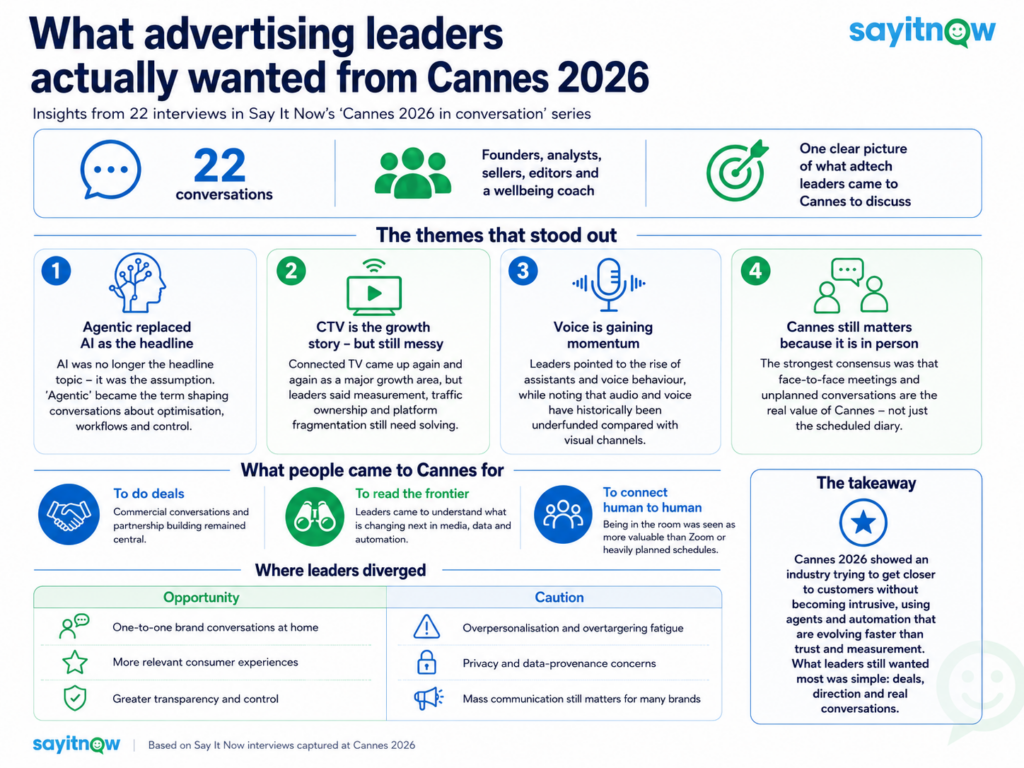
Every June, the industry decamps to the French coast. So when Say It Now took a microphone onto La Croisette for its “Cannes 2026 in conversation” series, the answers doubled as a read on where adtech’s collective head is at. Across twenty-two conversations with founders, analysts, sellers, editors and one wellbeing coach caught between meetings, a clear picture emerged of what people came for, and where they quietly disagree.
Everyone has stopped saying “AI” and started saying “agentic”
AI is not the headline any more, it is the assumption. The word doing the real work in 2026 is “agentic”. Priti Ohri, co-founder and CEO of Advertible, put it simply: “Most conversations were about how agentic is changing the future of advertising.” Cadi Jones, who runs EMEA for Index Exchange, wanted to talk about AI and agentic tools bringing custom optimisation and models closer to the impression. Shane Shevlin, co-founder of media-buying platform Bedrock, was there to understand how large agency buyers are squaring their agentic workflows with the awkward question of data provenance.
Underneath the jargon sits a genuine structural shift. Buying is moving closer to supply, and capability is moving back in-house. Meraj Kunarajah of Xapads described his pitch as “democratising YouTube intelligence”, taking contextual targeting out of the black box, much as agencies once reclaimed their trade desks. Ruairi Pammen, who founded publisher house Ad Scope, was blunter: “You got to spend money to make money, so we’re here to do some deals.” Whatever the acronym, the theme is transparency and control.
Not everyone was thrilled about it. Robin Langford, editor of Performance Marketing World, admitted he was “trying to avoid talking about AI, which is very, very difficult here”, preferring the more human “intersection between creativity and technology and data.” His fatigue is worth noting. When the loudest theme at Cannes is also the one an experienced editor is actively dodging, the industry may be nearing peak AI narrative.
CTV is the growth story that still cannot behave itself
If agentic was the how, connected TV was the where, and it surfaced again and again as a problem still unsolved. Alex Dawson-Smith of EX.CO, whose company has moved from online video into CTV, called the space “the wild west”, still wrestling with who owns the traffic and how it behaves across each operating system. Omdia’s David Tett listed shoppable TV as the development “always looming but never quite arriving.” Zac Pinkham, now SVP International at Samba TV, wanted to watch how the big players use data as consolidation reshapes the market. The money is flowing into CTV faster than the standards can keep up.
Voice, long the poor relation, is having a moment
Given the host, a thread on voice was inevitable, but the enthusiasm was striking. Silke Zetzsche of AudioStack argued that brands “have been for a long time thinking only in visual layers”, while audio has been “chronically underfunded.” The shift from browsers to AI assistants is what changes the maths. David Tett noted that assistant usage has “gone from nothing to a huge amount of daily usage”, and that platforms once allergic to advertising have relented because the dollars have spoken. Ed Rigg of RecDek made the behavioural case: “humans are inherently lazy and typing takes time,” so voice wins. It is a conclusion that happens to suit a company building branded voice conversations, but the people who reached it were not selling audio themselves.
The point of Cannes is still the bits you cannot plan
On one question, the room was almost unanimous: why fly to France when you could do this on Zoom? Because you cannot. Cadi Jones, sixteen meetings deep in a single day, said “nothing beats being in the room.” Jamie Barnard of Compliant made the sharpest version of the argument: “the best thing about Cannes is the unplanned stuff that happens all around the fringes. I actually think people are getting way too into planning mode.” Ruairi Pammen tied it to the moment, noting how much human connection has been lost to hybrid working. Even the cause-led answers, from Refluenced’s push for a fair creator economy to Advertible’s conversations on female leadership, depended on being physically present. Ground+Air’s Jim Brown and Mark Kelly were there for the most human theme of all, executive burnout, a reminder that the people running this machine are also quietly asking how to keep going.
Where the leaders part company
The consensus frays around the question closest to the host’s own business: is there real value in a brand talking one-to-one with a consumer at home? Most said yes, often emphatically. But the dissent is the interesting part. Denise Breslin of Navigator sat deliberately on the sidelines: one-to-one matters, “but actually what I think is more important is the ability to speak to your audience en masse.” Jamie Barnard was blunter still: “I’m less convinced by that. We have to see.” Others liked the idea but flagged the catch. Shane Shevlin warned that younger audiences are “becoming tired with overpersonalisation and overtargeting”, and that the trick is connecting “without shoving your product in their face.” Alex Dawson-Smith summed up the ambivalence neatly: “sure. Scares me, because of the amount of information that we’re giving over at times, but absolutely.”
The takeaway
Cannes 2026 was a festival of people trying to work out how to get closer to the customer without being creepy about it, using agents they do not fully trust yet, in channels growing faster than they can be measured. The tools change every year. What people actually came for did not: a deal, a signal about the frontier, and a conversation that only happens face to face. As Advertible’s Priti Ohri put it, you can drink rosé over Zoom, “but it’s more fun when we do it together.”