
Alexa+ vs ChatGPT and Gemini: Distribution Meets Action
TL;DR
- The operational footprint to engage with #Alexa increases from 600m smart speakers to anyone who had a browser (or downloads the app)
- Alexa goes head to head with ChatGPT/Gemini/Claude who focus general-purpose reasoning and content engines, Alexa+’s positioning is ‘home assistant’ and ‘getting tasks done’.
- The scene is set for full funnel execution within the conversation
- Brands already investing in Alexa will carry that learning and outcomes through to the new Alexa paradigm
- The Household Operating System: Amazon’s Real Alexa+ Play
Amazon’s new Alexa.com experience is basically Amazon saying: “Alexa+ is not just a smart-speaker thing anymore. It’s a full consumer AI assistant, and it wants to sit at the same table as ChatGPT and Gemini.”
The update consists of an updated Alexa app and website that look very similar to other AI assistants like Claude, ChatGPT and Gemini. The massive difference is that the Alexa+ offering sits on top of 600m+ Alexa smart speakers which sit at the heart of millions of households and are being used daily.
New capabilities will allow agentic actions to be performed for the user like booking a test drive, call back, signing up for a newsletter, downloading an app, reserving a table, buying a product or thousands of other actions that previously relied on the consumer performing an action in a browser.
Amazon really, really understands consumers, how to make their lives easier and eventually help them buy more. The ability to communicate with Alexa+ on the browser, app and pick up the conversation with your voice whenever you are within earshot of a smartspeaker is massively powerful.
In Feb 2025 Amazon announced the next generation of Alexa, Alexa+. This was the long awaited LLM powered version of Alexa promising a more seamless conversational experience with the ability to hold context. A shift from a command and control system where you issue orders to be completed in the moment to a true assistant that can understand context, memory and perform more complicated tasks.
The Alexa+ and Alexa.com update will be rolled out free of charge to all Prime members although Amazon have not yet announced a release date for the UK.
What the Alexa.com announcement actually changes
Amazon has started rolling out Alexa.com to Alexa+ Early Access customers, so you can use Alexa+ in a browser, pick up conversations across devices, and keep context synced between web, the Alexa app, and devices like Echo and Fire TV.
That matters because it removes one of the big historical weaknesses of voice assistants: “great in the kitchen, awkward at a desk”. Now Alexa+ can do keyboard-and-screen work (planning, writing, research, itinerary building) and then hand off to voice when that’s more convenient.
How this positions Alexa+ against other consumer AI assistants
1) Distribution is the superpower (600m+ endpoints)
Amazon keeps pointing to “over 600 million Alexa-enabled devices” out in the world. That is a large distribution advantage which will compliment a .com offering that will be available worldwide.
ChatGPT and Gemini are everywhere in software, but Alexa is everywhere in rooms. Amazon is trying to fuse those: room presence + chat UI + continuity.
2) “Talk is cheap. Action is expensive.” Alexa+ is leaning into action
Amazon’s message is not “best answers”. It’s “get things done”: orchestrating actions across “tens of thousands of services and devices”, doing reservations, shopping, smart home control, calendars, etc.
That is a different wedge vs ChatGPT/Gemini, which are often strongest as general-purpose reasoning and content engines, but only become “do-ers” when they have deep integrations and user permissions. Amazon Prime accounts have a load of these out of the box and a load of ancillary context from around the home.
3) The home is still the fortress
Amazon wants Alexa+ to be “everywhere” (home, phone, web) but differentiate by focusing on families and home needs.
In the near-term I believe the differentiator is consumer vs. B2B use cases. A home assistant and a work assistant? I believe we’ll all have many specialist assistants for work but we’ll probably only want one assistant to support our home and family tasks. Over time we’ll allow that assistant more and more access and permissions. Much like the onboarding journey you had with your first smartphone, gradually adding ‘apps’.
Siri owns the iPhone moment, Google tends to own the search and Android moment, and Amazon is trying to own the “household operating system” moment.
4) Cross-surface continuity is the stealth feature
Persistent context across endpoints (start on web, continue on Echo, pick up on phone) sounds mundane, but it is exactly the behaviour users already have with ChatGPT, however, if the home has smarter speakers in earshot you can pick up any task or thread of thought as it pops into your mind.
This delivers on the long awaited promise of ‘ambient computing’, all digitally provisioned information and services available to you all around you all the time, you just have to speak to access it via your own personal assistant.
This is how Alexa+ becomes a primary or home assistant, rather than a “voice remote control”.
Why the 600m install base matters (beyond bragging rights)
A large installed base matters when three conditions are true:
- Frictionless upgrade path: “Once enabled, Alexa+ will be on compatible devices” suggests Amazon is aiming for a software-forward upgrade, not a hardware repurchase cycle.
- Habit loops already exist: millions of households already use Alexa for routines, music, timers, and smart home. Amazon is betting Alexa+ makes those habits stickier and expands them into higher-value tasks.
- Network effects for integrations: more users makes it rational for partners to build “agentic experiences”
What this news unlocks for brands
This is where it gets tasty for “agentic advertising”.
1) Voice ads can drive real actions, not just clicks
Alexa+ is genuinely action-oriented (book, buy, schedule, control), then a voice call-to-action becomes a conversion funnel: “Ask Alexa to…” can complete the job, not just hand off to a website.
Say It Now designs, deploys, and measures those conversational funnels for brands.
2) Web access makes campaigns easier to finish
Alexa.com gives a screen-based continuation path. Someone hears an audio or TV prompt, starts with voice, then completes details on web (forms, options, confirmations) without losing context. That reduces drop-off in the messy middle.
3) Better measurement stories
Amazon claims meaningful behaviour lift in early usage (more conversations, more purchases, more recipe requests). Even if you treat those as directional, the core point is: Alexa+ is being instrumented as a modern assistant, which tends to mean better event data and journey visibility.
Say It Now delivers metrics like Voice Through Rate and downstream outcomes (lead submitted, booking made, basket created).
Where Say It Now comes in
What
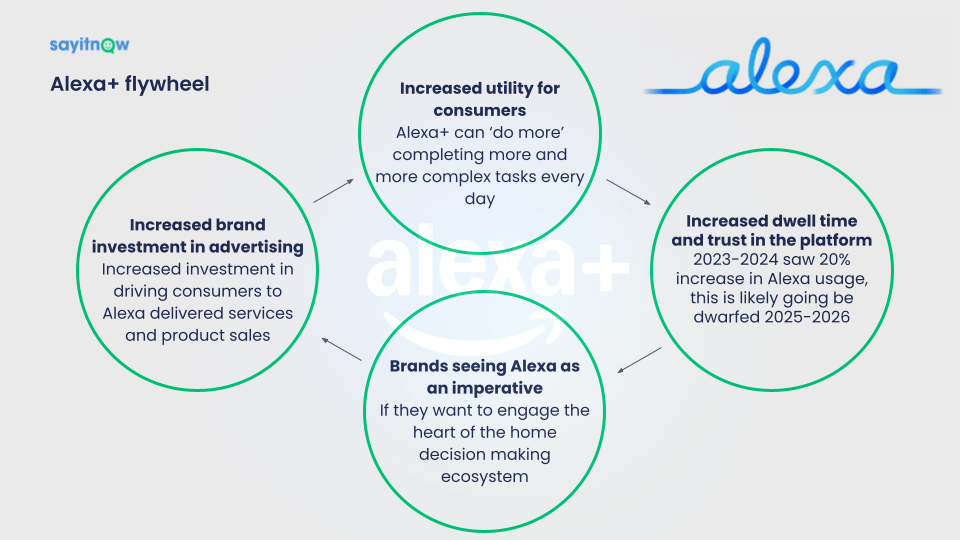
Consumers are moving away from browsers and to AI assistants. Their everyday dwell time with Alexa+ is increasing daily.
Why
Consumers using Alexa+ are shopping and cooking with the assistant at 3-5x previous rates.
Companies have the ability to control the conversations consumers have with their brands rather than having Alexa speak on their behalf.
How
Say It Now’s Studio builds, manages and measures conversations within Alexa and Alexa+. Brands use our platform or we work on their behalf.
To arrange a meeting to explore how to set up your company within Alexa get in touch now.